
PI: Mikaela Provost, Assistant Professor in Quantitative Fisheries in the Department of Wildlife, Fish, and Conservation Biology at UC Davis.
My research uses theoretical and empirical approaches to address applied problems in fisheries management and marine conservation. My projects span multiple species and places, and the methods I use can be adapted for a wide variety of taxa.
Postdocs

Jessie Bolin
I am a quantitative marine ecologist and data scientist interested in applied research for a more proactive, sustainable and climate-resilient world. Broadly, my research interests span seafood sustainability, climate change, dynamic risk adaptation, ecological forecasting and functional programming. My postdoc involves modeling and mapping ‘climate refugia’ for red abalone across California’s marine estate, to support climate-resilient populations of abalone under changing ocean conditions. I completed my PhD at UniSC Australia and CSIRO Environment in 2024 on fisheries forecasting and climate adaptation, where I was a Chapter Scientist for the ‘Oceans and Coastal Ecosystems and their Services’ chapter for the IPCC’s Sixth Assessment Report. I love the outdoors, and outside of work, you can most likely find me hiking in Desolation Wilderness, surfing in Monterey Bay, or at the climbing gym.
Graduate Students
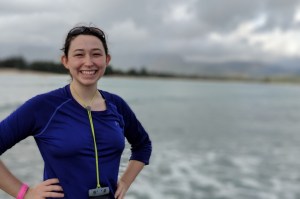 Mattea Berglund, PhD student (GGE)
I am broadly interested in relationships between people and aquatic ecosystems. I combine field, lab, and quantitative methods to study how human-driven change impacts the health, distribution, and composition of aquatic communities. My research has spanned salt marshes, artificial reefs, hatcheries, rivers, and wetlands across the country. Through collaborative, interdisciplinary research, I aim to develop tools to support equitable and effective management of aquatic ecosystems. As an Asking Different Questions Scholar, I think a lot about the practice of science, community-engaged research, and how science interacts with other social structures. I am committed to supporting students and early career scientists, and work to provide mentorship and demystify academic processes through programs such as Ecology and Evolution Graduate School Preview Program, Graduate Writing Fellows Program, and Letters to a Pre-Scientist.

Sophia Pelletier, PhD student (GGE)
I am a first-year PhD student in the Graduate Group of Ecology. Broadly, I am interested in investigating how marine ecosystems are responding to anthropogenic stressors. My graduate projects will be focused around fisheries ecology and using models to ask questions centered around fisheries management and sustainability.
I am also deeply interested in education and the importance of communicating science to broad audiences. Prior to starting graduate school, I was an educator at a land trust in Washington State where I wrote and taught curriculum centered around conservation and land management. I am looking forward to integrating education and science communication into my graduate projects.

Corey Kramer, PhD student (GGE, joint-doc UCD-SUSD)
I’m a PhD student who is a part of the joint doctoral program in ecology between the University of San Diego State and UC Davis. I’m primarily a spatial ecologist, who is also interested in population dynamics and species interactions. All of my work thus far has focused on large mammals with an emphasis on applied research intended to help inform management action. During my MSc I used GPS collar data to understand 1. habitat selection and identify movement corridors of invasive wild pigs in Canada to identify areas at highest risk to pig related damages within Canadian agroecosystems and 2. identify inter-country transboundary corridors that could facilitate wild pig moments into the northern United States. I’m also a part of a project focused on the statistical evaluation of the roles changing sea ice and human presence have on polar bear body condition, and what influence these factors have on the likelihood and mitigation of human bear conflict. Thus far, my PhD work is focused on using ground and helicopter survey data to generate population trajectories of the endangered Peninsular bighorn sheep within the Peninsular Range of southern California and Mexico. After the completion of this project, I intend to focus on a spatially oriented project studying bighorn habitat selection or the role each sex plays in regional connectivity before finishing with a study focused on species interactions between bighorn, mule deer, and cougars.
 Hunter Milles, PhD student (GGE, joint-doc UCD-SDSU)
Broadly, I am interested in facilitating dynamic ocean management in the face of changing oceans. My work leverages quantitative approaches to characterize and forecast the spatial and temporal responses of marine species to climate change. To this end, my PhD research combines diverse data types to illuminate redistributions of highly migratory species—such as sharks, tunas, whales, and forage fish—with the goal of informing climate-resilient management strategies. Prior to starting my PhD, I completed my undergraduate at Oberlin College, where I synthesized disparate data types, including citizen-science records, scientific surveys, and environmental impact assessments to characterize the distribution of whale sharks in the Northwest Atlantic Ocean.
Undergraduate Students

Amanda Maldonado
Amanda is an undergrad majoring in Animal Biology with a minor in Wildlife, Fish, and Conservation. Amanda is interested in pursuing a career in veterinary medicine and doing research in marine animal conservation.

Lorenzo McCleese
I am a second-year student at the University of Washington studying Environmental Science and Informatics, with a minor in Diversity. As I pursue my degree, my passions primarily focus on research, environmental justice, and promoting diverse outreach and inclusion. Specifically, I hope to study climate change through the lens of remote sensing and data science.
Outside of academics, I am dedicated to strengthening underserved communities on and off my college campus. I plan to carry these community-building experiences into my future career in research, where I aim to create impactful and inclusive solutions to environmental challenges. In my free time, I enjoy hiking, listening to music, exploring new places, and playing basketball.
Alumni
 Caroline Newell, Masters (GGE) 2023-2025, currently Sea Grant fellow at the Fish and Game Commission
 Mikaela M. Provost